The stairs in most homes are used dozens of times a day without a second thought. Then a toddler starts climbing, or a parent moves in for the winter, or someone comes down in socks carrying a laundry basket and misses the last step, and suddenly the staircase looks different. It’s the one place in the house where everyone, from the two-year-old to the eighty-year-old, is moving between levels on a narrow strip of wood or carpet with gravity working against them.
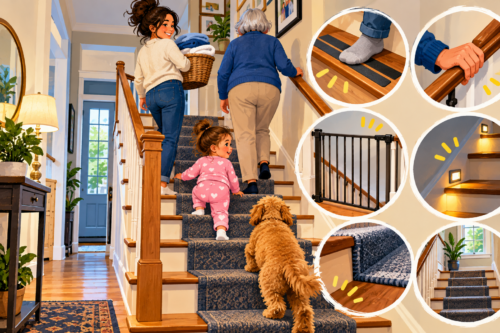
The good news is that stairs are one of the easiest parts of a home to make safer, and most of the fixes are cheap, quick, and don’t require a contractor. This guide walks through the stairs from top to bottom, covering what to change for small children, older adults, pets, and everyone in between.
Why Stairs Deserve Attention
Stair injuries aren’t rare, and they aren’t limited to the elderly. According to Nationwide Children’s Hospital, a study published in Pediatrics found that more than 93,000 children under five were treated in U.S. emergency departments for stair-related injuries over a ten-year period, roughly one child every six minutes.
At the other end of the age range, stairs are one of the most common sites of falls among older adults. In between, the rest of the family trips over toys, slips in socks, and misjudges the bottom step in the dark. The same handful of changes protects all of them.
Start With Light
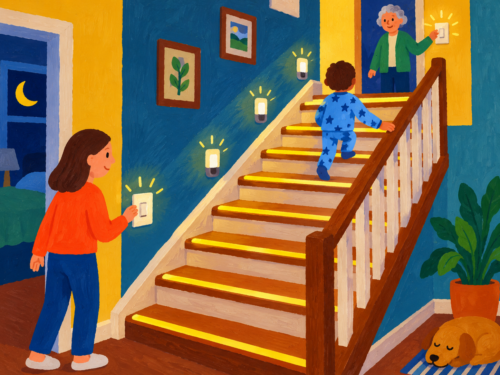
Most stair accidents happen because someone couldn’t see the edge of a step. Fixes:
- Light switches at both the top and bottom, so no one climbs in the dark to reach a switch
- Motion-sensor or plug-in night lights along the stairway for late-night trips
- Even lighting that doesn’t cast a shadow across the treads; a single bulb at the top often does
- Contrast on the step edges, with a lighter or darker strip so each tread is visible, especially on carpeted stairs where every step blends into the next
Fix the Surface
A slippery tread is the single biggest hazard on a staircase, and it affects everyone:
- Remove or secure loose carpet runners. A runner that shifts underfoot is worse than no runner at all
- Check for worn carpet on the nosing (the front edge of each step), where it goes shiny and slick
- Hardwood and tile stairs need traction. Socks on polished wood is how many adults end up on their backs
- Outdoor steps, including the porch, deck, and garage entry, get wet, icy, and mossy and are often the most dangerous steps on the property
For hard-surface and outdoor stairs, the straightforward solution is to buy anti slip treads that can be placed on stairs along the edge of each step, where feet actually land.
GripStrip, for example, makes screw-down plastic strips in several widths and colours, including a high-visibility yellow and a gentler version for bare feet and pet paws, that fit wood, composite, concrete, and metal steps and hold up to weather, shoveling, and pressure washing. Whatever product you choose, look for something that stays put without relying on adhesive that peels in the cold, sits flush so it isn’t a trip hazard itself, and can be installed in an afternoon with basic tools.
Handrails That Actually Help
Many homes have a handrail that looks fine and isn’t:
- Both sides of the stairs should have a rail if possible, especially where older adults or small children use them
- Graspable shape. A rail should be something a hand can wrap around, not a wide flat board
- Full length, extending past the top and bottom steps so there’s support on the first and last stride
- Solidly anchored into studs; test by pulling hard on it
- Correct height, roughly 34 to 38 inches above the step nosing for adults, and a second lower rail for young children where practical
Gates for the Youngest Climbers
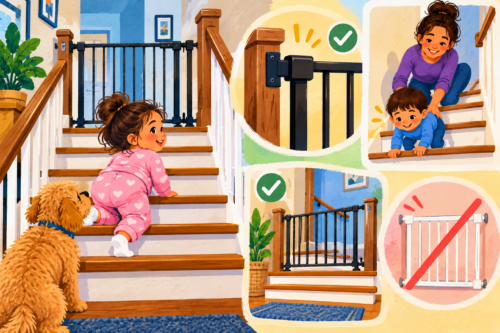
For toddlers and crawlers:
- Hardware-mounted gates at the top of the stairs, never pressure-mounted ones, which can be pushed over
- A gate at the bottom too, set a step or two up so the child can practice climbing safely
- Gates with a swing door rather than a step-over design, which adults trip on while carrying a child
- Teach stair skills early, going down backward on hands and knees, and supervise until they’re steady
Clear the Path
A surprising share of stair falls involve something that shouldn’t have been there:
- Nothing stored on the steps, not even “just for a minute.” The basket of things to carry up is the classic culprit
- No loose rugs at the top or bottom landing, or secure them with non-slip backing
- Cords, shoes, and toys kept clear of the landings
- Pets taught to wait rather than race past on the stairs; a dog bolting between legs is a common cause of adult falls
Think About Older Family Members
If an older relative lives with you or visits often:
- Make sure rails are on both sides and easy to grip
- Improve lighting and add contrast strips, since depth perception declines with age
- Consider a landing chair or a place to rest on long flights
- Keep a phone or call device reachable from the stairs
- Look into a stair lift if stairs are becoming a daily struggle; it’s often cheaper than a fall
A few thoughtful changes can make stairs safer and easier for older adults, helping them stay confident and independent at home.
A Few Habits That Cost Nothing
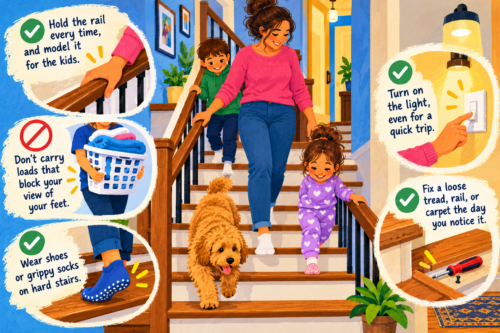
Simple everyday habits can go a long way toward making stairs safer for everyone in your home.
- Hold the rail every time, and model it for the kids
- Don’t carry loads that block your view of your feet
- Wear shoes or grippy socks on hard stairs
- Turn on the light, even for a quick trip
- Fix a loose tread, rail, or carpet the day you notice it
These small, no-cost precautions take only a moment but can help prevent slips, trips, and falls before they happen.
A Ten-Minute Stair Audit
Walk the stairs slowly and check:
- Can you see every step edge clearly, day and night?
- Does any step feel slippery in socks?
- Does the rail wobble or stop short of the top or bottom step?
- Is anything stored on the steps or landings?
- Are the outdoor steps wet, icy, or mossy?
- Could a toddler reach the top step unsupervised?
Each “yes” or “no” that worries you points to one of the fixes above.
Conclusion
Making your home’s stairs safer for the whole family comes down to a short list: good light at both ends, a surface with real traction, especially on hard and outdoor steps, handrails that can be gripped along the full length, gates for the youngest climbers, landings kept clear, and a few habits everyone follows.
None of it is expensive, most of it takes an afternoon, and together it protects the toddler learning to climb, the teenager taking the steps two at a time, and the grandparent who’s a little less steady than last year. Walk your stairs with fresh eyes this weekend, and fix what you find.
Leave a Reply