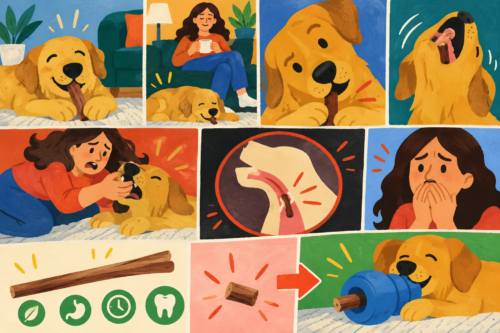
Every dog owner who hands over a bully stick knows the moment. For twenty blissful minutes the house is quiet, the dog is absorbed, and everyone relaxes. Then the stick gets short. The dog shifts its grip, tilts its head, and tries to work the last two inches to the back of its mouth, and suddenly you’re on the floor prying open jaws, or watching anxiously while it gulps, or realizing you’ve been lucky every single time before this.
That last stub is where the danger lives. Bully sticks are one of the best chews available: natural, digestible, long-lasting, and great for teeth. But the end piece is exactly the size and shape to lodge in a throat, and most dogs will try to swallow it whole rather than give it up. A bully stick holder exists to solve that one problem, and it does so simply. Here’s why the risk is real and how the right holder removes it.
A Lot of Dogs, a Lot of Chews
The number of households facing this small daily decision is enormous. According to the American Veterinary Medical Association, 42.6 percent of U.S. households owned a dog in 2025, which works out to 56.3 million households and 87.3 million dogs.
Chewing is a natural need for nearly all of them, and bully sticks are among the most popular ways to meet it. That means millions of end pieces every week, each one a swallow waiting to happen if nobody intervenes.
Why the Last Piece Is the Problem
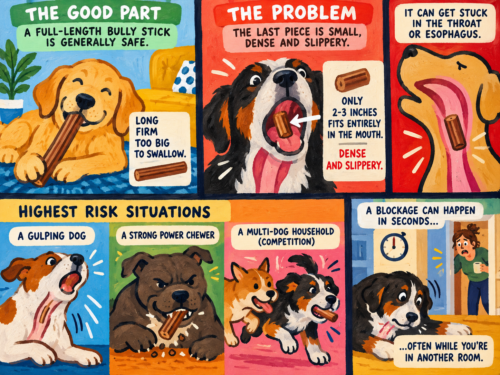
A full-length bully stick is safe for most dogs because it’s too long to swallow and too firm to break off in chunks. The risk rises as it shrinks:
- At two to three inches, the piece fits entirely inside the mouth
- Dogs instinctively try to swallow a chew they’re about to lose rather than drop it
- The piece is dense and slippery, so it can lodge in the throat or esophagus instead of passing
- Gulping dogs, power chewers, and multi-dog households where competition drives speed are at the highest risk
- A blockage can happen in seconds, often while the owner is in another room
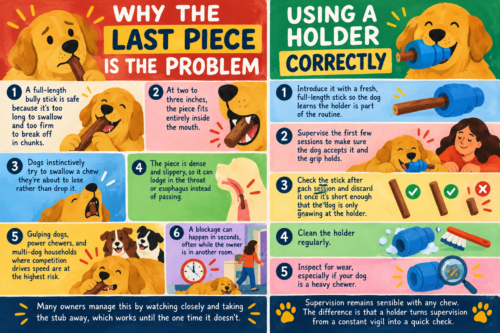
Many owners manage this by watching closely and taking the stub away, which works until the one time it doesn’t.
What a Holder Does
A bully stick holder is a device that grips one end of the stick so the dog can chew the exposed portion but can’t swallow the remainder. The holder is larger than the dog’s mouth, so when the stick is chewed down to the last couple of inches, the dog simply can’t get it past its lips. The stub stays locked in place until you remove it and throw it away.
The practical effects:
- The dog chews the full length of the stick safely, including the part you’d normally have to confiscate
- You get the quiet twenty minutes without hovering
- Less waste, since the stick is used almost entirely rather than discarded at the three-inch mark
- The holder doubles as a base, keeping the stick off carpets and furniture
In short, a bully stick holder lets your dog enjoy every last chew while giving you greater peace of mind and less mess.
Choosing the Right Holder
Not every holder suits every dog, and a poorly fitting one can be its own hazard. The features that matter:
- A grip that actually holds. The stick should not pull free under determined chewing. Screw or clamp mechanisms outperform simple friction fits.
- Adjustability. Bully sticks vary in thickness; a holder that tightens to the stick rather than relying on a fixed hole works across sizes.
- Size relative to the dog. The holder itself must be too large to swallow and too tough to chew apart.
- Safe materials. Food-grade, durable plastics or silicone-covered designs that don’t splinter.
- Easy cleaning. Bully sticks are greasy; a holder that disassembles and washes matters.
- Compatibility with other chews. Some holders also grip collagen sticks, yak chews, and similar treats.
A good example of the category is the adjustable bully stick safety holder from Bully Bunches, which tightens to fit different stick thicknesses and is sized for small, medium, and large dogs. Whatever holder you choose, the test is the same: load a short stub, hand it to your dog, and confirm it can’t be worked loose.
Using a Holder Correctly
A holder reduces risk substantially, but it works best as part of sensible chew habits:
- Introduce it with a fresh, full-length stick so the dog learns the holder is part of the routine
- Supervise the first few sessions to make sure the dog accepts it and the grip holds
- Check the stick after each session and discard it once it’s short enough that the dog is only gnawing at the holder
- Clean the holder regularly
- Inspect for wear, especially if your dog is a heavy chewer
Supervision remains sensible with any chew. The difference is that a holder turns supervision from a constant vigil into a quick check.
Beyond Choking: Other Benefits
Once the swallowing risk is handled, bully sticks become an even better tool. Chewing relieves boredom and anxiety, supports dental health by scraping the teeth, and gives high-energy dogs an outlet.
Owners who previously limited bully sticks because of the end-piece worry often find they can offer them more freely, which benefits the dog’s behavior and wellbeing. A holder also makes it easier to give a chew to a dog in a crate, during travel, or while guests are over, situations where close supervision is harder.
Conclusion
A bully stick holder helps reduce choking risks by addressing the one part of an otherwise excellent chew that’s genuinely dangerous: the short end piece a dog will try to swallow rather than surrender.
By gripping that stub so it can’t pass the lips, a well-designed, properly sized holder lets the dog enjoy the whole stick while the owner relaxes, and it reduces waste along the way. With tens of millions of dogs chewing in American homes, that small device solves a common problem at a very low cost. Choose one that fits, test it, keep it clean, and the quiet twenty minutes ends with a scramble on the kitchen floor.
Leave a Reply