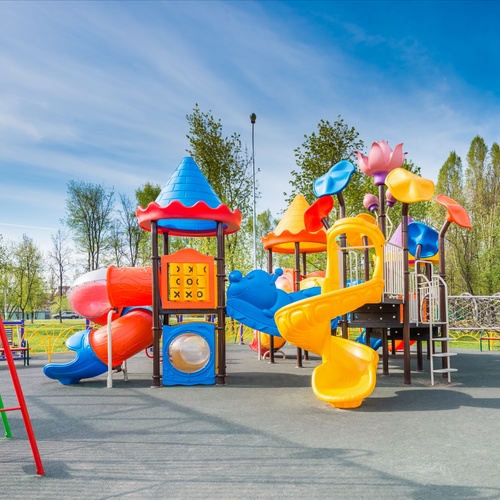
A school playground can look impressive on paper and still leave children standing around wondering what to do. Kids need spaces that invite movement, imagination, social interaction, and just enough challenge to keep recess interesting. Thoughtful playground design considers how children actually behave instead of simply filling available space with equipment.
When schools approach planning from this perspective, the playground can become one of the most valuable spaces on campus. Creating school playgrounds kids actually want to use means considering their needs and their wants—let’s explore.
Start With How Kids Really Play
Adults often organize playgrounds according to equipment categories, but children rarely think about recess that way. They run between activities, invent games, follow friends, change their minds, and turn ordinary spaces into imaginative worlds. A successful layout supports that natural movement without making the playground feel overly structured. Designers should watch how students use existing spaces and consider what consistently captures their attention.
Age also influences what children find exciting, comfortable, or challenging. Younger students may gravitate toward imaginative elements, manageable climbing challenges, and opportunities for cooperative play. Older elementary students often want greater physical challenges, social gathering areas, and activities that let them test their abilities. Schools that serve several grade levels should create enough variety so that nobody feels that the playground belongs to another age group.
Give Kids More Than One Way To Move
A playground dominated by one large structure can create excitement initially, but that excitement may fade when children have limited choices. Kids benefit from opportunities to climb, swing, balance, spin, crawl, jump, and run throughout the same play area. These different movements help children develop coordination while giving them options that suit their preferences and confidence levels. Variety can also distribute students throughout the playground instead of concentrating everyone around one popular feature.
Swings deserve special consideration because children can enjoy them in surprisingly different ways. Schools exploring different types of playground swings may find traditional belt seats, inclusive designs, group swings, and younger-child options that serve distinct needs. Providing several choices can make a familiar playground activity accessible and interesting to more students. Schools should also consider how swing placement affects traffic patterns because children need clear pathways around moving equipment.
Create Spaces for Different Personalities
Not every child races toward the tallest climbing structure when recess begins. Some children want energetic competition, while others prefer talking with friends, experimenting with imaginative games, or enjoying quieter activities. A playground should respect those differences instead of treating nonstop physical activity as the only worthwhile form of play. Thoughtful zones can help more students find a comfortable place where they genuinely want to spend recess.
Schools can create better variety without turning the playground into a complicated collection of disconnected areas. A few purposeful spaces can support several styles of play while maintaining a cohesive layout. Families, teachers, and planners might consider features, such as:
- Open areas for running, tag, and student-created games.
- Climbing structures with challenges at multiple skill levels.
- Swings and motion-based equipment for sensory-rich movement.
- Gathering spaces where children can talk and socialize.
- Imaginative elements that encourage pretend and cooperative play.
- Accessible activities that welcome children with different abilities.
Plan the Layout Around Natural Movement
Great equipment cannot compensate for an awkward playground layout. Children need enough room to move between activities without constantly crossing through swing paths, crowded entrances, or active games. Clear circulation routes help students understand the space intuitively while giving supervising adults better visibility. Schools should consider movement patterns before deciding exactly where every structure belongs.
Current trends in playground planning and layouts increasingly encourage designers to think beyond a single central play structure surrounded by empty surfacing. Schools can create connected experiences through activity zones, pathways, gathering areas, landscaping, and equipment that encourages different forms of movement. This approach can make a playground feel larger because children discover multiple destinations instead of one obvious attraction. It also gives schools greater flexibility when they need to accommodate different ages, abilities, and recess schedules.
Make Inclusion Part of the Experience
Accessibility should shape playground planning from the beginning rather than appear as a final addition. Children with mobility, sensory, communication, or developmental differences deserve meaningful opportunities to participate alongside classmates. Accessible routes matter, but schools should also consider whether those routes lead to engaging activities rather than simply providing entry into the space. Inclusive design works best when children can share experiences instead of separating into entirely different play areas.
Sensory variety can broaden participation even further. Schools might combine movement-focused equipment with tactile features, musical elements, imaginative panels, comfortable gathering spaces, and calmer areas. Children experience environments differently, so providing several ways to interact can make recess more welcoming. A playground that acknowledges those differences can support stronger friendships and a greater sense of belonging.
Ask Students What They Actually Want
Adults can research equipment endlessly, but students bring firsthand knowledge about what happens during recess. Schools can gather feedback through classroom conversations, simple surveys, drawings, or age-appropriate planning activities. Children may identify overlooked problems, such as crowded equipment, nowhere comfortable to talk, or activities that only appeal to certain grades. Their input can reveal priorities that adults might never notice during a brief playground walkthrough.
Student participation can also create excitement around the playground renovation or expansion. Children feel a stronger connection to spaces when they know adults listened to their ideas. Schools don’t need to implement every request, especially when budget, maintenance, or safety considerations create limitations. Instead, planners can look for recurring themes and translate those preferences into realistic design decisions.
Think Beyond Opening Day
A playground should continue serving students years after the ribbon-cutting photos disappear. Schools need durable equipment, sensible layouts, maintainable surfacing, and enough flexibility to support changing enrollment and student interests. Planning for inspections, repairs, replacement parts, landscaping, and future additions can protect the school’s investment. A slightly simpler playground that remains functional often provides more long-term value than an elaborate design that becomes difficult to maintain.
Schools should also evaluate how the playground performs after students start using it. Teachers and recess supervisors may notice congestion points, underused spaces, or unexpected activities that reveal opportunities for improvement. Small adjustments to seating, markings, pathways, or activity areas can sometimes make a significant difference. Playground planning works best as an ongoing process rather than a one-time purchasing decision.
Build a Playground That Earns Their Excitement
Children quickly reveal whether adults designed a playground for appearances or for actual play. The spaces they love usually offer variety, manageable challenges, social opportunities, imaginative freedom, and enough flexibility to make every recess feel slightly different. Schools can create playgrounds kids actually want to use by studying student behavior, listening to children’s ideas, and considering the entire layout instead of focusing exclusively on individual equipment pieces. When thoughtful planning meets genuine understanding of how kids play, the playground becomes a place students cannot wait to use.
Leave a Reply