Look at any new office, apartment building, or contemporary home, and the roofline is likely to be a clean horizontal edge. The pitched roof hasn’t disappeared, but the flat roof has moved from industrial necessity to design statement, and the reasons run deeper than fashion.
Architects working in Chicago and other dense, urban markets are turning to flat roofs for reasons that go well beyond appearance. What’s actually driving that shift takes a closer look to understand.
Here’s exactly what’s driving this shift.
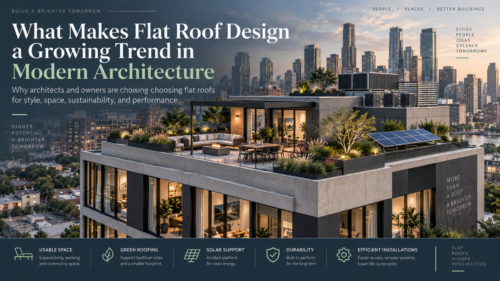
Flat Roofs Suit Clean, Minimalist Architecture
Modern architecture favors simple volumes, uninterrupted lines, and honest materials, and a flat roof completes that language in a way a gable never can. It lets walls read as pure planes, allows floor-to-ceiling glazing without awkward eaves, and keeps the building’s silhouette crisp against the sky.
The flat roof also frees the floor plan. Without a pitched attic, ceiling heights can run consistently across a level, clerestory windows can bring light deep into a plan, and rooms can extend to the building’s full footprint. For designers, that flexibility is worth more than the drama of a peaked roofline, and clients increasingly agree once they see the interiors it makes possible.
Flat Roofs Turn Rooftops Into Usable Space
In cities where land is the scarcest resource, a flat roof is a free extra floor. Developers and homeowners now design the roof as a destination rather than a lid, and the uses keep expanding:
- Roof decks and terraces with outdoor kitchens and seating
- Rooftop gardens and small-scale urban farming
- Amenity spaces for apartment and office buildings
- Play areas and quiet retreats above the street noise
A pitched roof can’t offer any of that. Usable rooftop space raises property value, improves quality of life, and gives buildings a social layer that street level can’t provide.
Flat Roofs Support Green and Cool Roof Systems
Sustainability is a major driver, and flat roofs are the natural platform for the technologies that deliver it. The EPA’s heat island program reports that the surface temperature of green roofs can be 56°F lower than conventional roofs. A flat, load-bearing surface is exactly what’s required to actually build and maintain one.
Reflective cool-roof membranes, which are simplest to install on flat surfaces, cut summer heat gain and cooling costs. Cities increasingly require or reward one or the other in new construction. A flat roof lets a building meet those standards without compromise, which makes the design choice an environmental one as much as an aesthetic one.
Modern Membranes Make Flat Roofs Durable
The old objection to flat roofs was leaks, and it was fair when tar and gravel were the only options. Today’s single-ply membranes such as TPO, PVC, and EPDM, along with modified bitumen systems, are engineered for ponding resistance, UV exposure, and thermal movement, with seams heat-welded rather than glued. Building owners comparing commercial roofing companies Chicago property managers rely on will find that membrane selection and tapered insulation design now matter more than the flat-versus-pitched question.
Getting the drainage and membrane details right is exactly the kind of work contractors like Lakeland Exteriors & Roofing handle when installing and servicing these systems. Properly designed drainage, with tapered insulation directing water to internal drains or scuppers, eliminates the standing water that shortened older flat roofs’ lives. With a good membrane and correct slope, a modern flat roof routinely delivers twenty to thirty years of service.
Flat Roofs Simplify Solar and Mechanical Installations
Buildings today carry more equipment on their roofs than ever, and a flat surface makes all of it easier. Solar arrays can be mounted on ballasted racks at the ideal tilt and orientation regardless of the building’s direction, which pitched roofs can’t offer. Mechanical systems benefit just as much:
- HVAC units sit on level curbs with easy service access
- Ductwork, conduit, and piping run without complex framing
- Maintenance crews work safely on a walkable surface
- Future equipment can be added without structural changes
For commercial owners, that accessibility translates into lower installation and maintenance costs over the life of the building. The roof becomes infrastructure rather than an obstacle.
Conclusion
The flat roof’s rise says something about where architecture is heading: buildings are being asked to earn their keep on every surface, and the roof is the last one that was sitting idle. Architects have stopped treating it as a lid and started treating it as a floor, a power plant, a garden, and a design statement all at once. That shift is why the horizontal roofline now appears on homes as readily as on warehouses. Owners who choose it are buying options they may not use for years, which is a rare quality in a structural decision. The pitched roof still has its place where snow and tradition favor it. But for anyone building with the next few decades in mind, the flat roof is the choice that keeps the most doors open. Function is pointing up, and design is following.
Leave a Reply