There’s a familiar arc to most home organization projects. A weekend of inspiration, a trip for matching bins and labels, and a pantry that looks like a magazine spread by Sunday night. Then real life resumes. The bins fill with the wrong things. The labels stop matching the contents. The beautiful system quietly reverts to the old chaos, and the only thing that changed is that the chaos is now sitting in nicer containers.

The problem usually isn’t effort or discipline. It’s that the system was designed for an imaginary household rather than the one that actually lives there. This is especially true in homes across Oklahoma, where different household routines, spaces, and lifestyles call for organizing systems that are built around real daily needs. Organization that lasts isn’t about copying what looks good online. It’s about building something that fits the way you cook, work, parent, and relax, so maintaining it takes almost no thought. Here’s why that fit matters and how to get it.
Disorganization Carries a Real Cost
The frustration of a home that won’t stay organized isn’t trivial. A recent survey reported by Forbes found that 74 percent of respondents felt stress or anxiety when confronted with cluttered areas of their home, 32 percent avoided inviting guests because of clutter, and 26 percent said it had hurt their relationships.
Those numbers describe people who have almost certainly tried to get organized before. The cycle of trying and failing is itself a source of stress, which is why the fit of the system matters more than its appearance.

The Systems That Fail, and Why
A few patterns show up again and again in organization that doesn’t last:
- Too many steps. If putting something away requires opening a cabinet, pulling out a bin, removing a lid, and sorting into a divider, it won’t happen on a Tuesday night.
- Wrong locations. Items stored where they look tidy rather than where they’re used, so they migrate back to the counter.
- Designed for one person. A system only the organizer understands collapses the moment anyone else in the household touches it.
- Ignores real habits. Pretending the mail will be sorted daily, or that shoes will go in a closet rather than by the door.
- Based on someone else’s life. A capsule-wardrobe closet for a person who loves clothes, or a minimalist kitchen for someone who cooks big family meals.
Each of these is a mismatch between the system and the lifestyle, not a failure of willpower.
Start With How You Actually Live
Before buying a single container, spend a week noticing:
- Where things naturally land when you walk in the door
- Which rooms get used most and for what
- What you reach for daily, weekly, and almost never
- Where clutter accumulates and what it’s made of
- Who in the household uses which spaces, and how
The answers reveal the real traffic patterns of your home. A system built on them works with your habits instead of against them.

Match the System to the Household
Different lives need different structures:
Busy families need simple, visible, low-step systems: open bins by the door, a single landing zone for school papers, labeled baskets a child can use without help.
People who work from home need separation between work and living, with storage that lets the office disappear at the end of the day.
Cooks need the kitchen arranged by workflow, with tools and ingredients stored at the point of use rather than by category.
Frequent entertainers need serving pieces accessible and a quick-reset plan for the main living areas.
Collectors and hobbyists need display and storage that honors what they love rather than hiding it.
Downsizers and empty nesters need help deciding what to keep, not just where to put it.
There’s no universal right answer. The right system is the one that matches the people in the house.
Where a Professional Fits In
Seeing your own habits clearly is hard, which is why people who are good at many things still struggle to organize their own homes. A professional organizer brings an outside eye, asks about how the household actually runs before touching anything, and builds systems around those answers rather than around a product catalog.
Pretty Neat OKC Professional Organizer takes this approach by starting with a conversation about daily routines and problem areas, then shaping the organizing process around what they learn and providing maintenance guidance so the system holds up afterward.
Most homes got disorganized for understandable reasons, and a good organizer treats that as a starting point rather than something to be embarrassed about. Whether you hire help or do it yourself, the principle is the same: the system should be shaped by life, not the other way round.
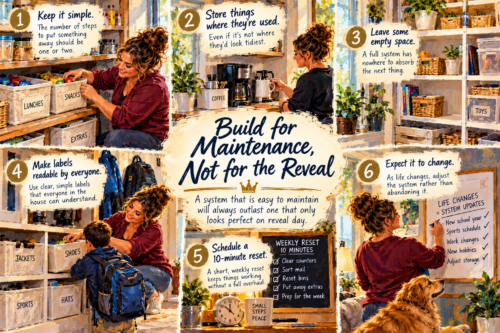
Build for Maintenance, Not for the Reveal
The reveal is the easy part. A system that lasts is one that’s maintained in small, almost unconscious moments:
- Keep the number of steps to put something away at one or two
- Store things where they’re used, even if it’s not where they’d look tidiest
- Leave some empty space; a full system has nowhere to absorb the next thing
- Make labels readable by everyone in the house
- Schedule a ten-minute reset weekly rather than a full overhaul yearly
- Expect the system to change as life changes, and adjust it rather than abandoning it
A system that is easy to maintain will always outlast one that only looks perfect on reveal day.
Signs Your System Fits
You’ll know the match is right when:
- Putting things away stops being a decision
- Other household members use the system without being reminded
- Surfaces stay mostly clear without effort
- You can find what you need in under a minute
- The home feels calmer rather than more controlled
If any of these are missing, the problem is the design, not you.
Conclusion
A home organization system should fit your lifestyle because the alternative, a system that fits an idealized version of your household, fails as soon as real life resumes, and the cycle of trying and failing adds to the stress that clutter already causes.
Start by watching how your home is actually used, design around those patterns with as few steps as possible, make the system usable by everyone who lives there, and plan for maintenance rather than a one-time reveal. Get the fit right, with or without professional help, and the matching bins finally hold what the labels say they do.
Leave a Reply