The Danube leaves Belgrade going more or less nowhere interesting. For the first hour you are on motorway, then on the flat agricultural roads of the Braničevo district, and the river itself is somewhere off to the left behind poplars and maize. I had been told the good part starts late. It does. Everything worth seeing on this stretch happens in the last third of the drive, which is a useful thing to know before you commit a day to it.
I went east in early autumn, with a driver, because I wanted to look out of the window rather than at a map. What follows is what the day actually contained, in the order it came, including the bits that did not land.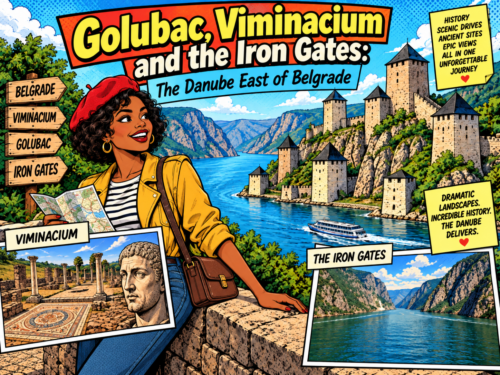
Viminacium, and the Problem of Distance
The first stop is not on the Danube at all, or not visibly. Viminacium sits in flat fields near Kostolac, roughly ninety kilometres out, in the shadow of a working lignite mine and a power station whose cooling towers you see long before you see any Rome. This was a legionary fortress and then a city: base of the Legio VII Claudia from the middle of the first century, and after the province of Moesia was divided, the capital of Moesia Superior. At its height it is thought to have held something like forty thousand people, which would have made it one of the larger cities in this part of the empire.
What you actually walk through is a fraction of that. The site covers some 450 hectares and only a very small share of it, in the region of three or four percent, has been excavated. The rest is under wheat. I found this more affecting than I expected: you stand at the edge of a dug rectangle looking at mosaic floor and brick hypocaust, and then you look up and there is nothing but field, and the field is the city.
Two things here are genuinely unusual. One is the third-century mausoleum found in 2018, which the excavators associate with the emperor Hostilian, who died at Viminacium in 251 during the plague that carried off a good part of the Roman world. The other has nothing to do with Rome. In the open-pit mine next door, diggers hit a nearly complete skeleton of a steppe mammoth, Mammuthus trogontherii, which the site staff call Vika. It has been dated to around 800,000 years ago. She now lies in a shelter a short walk from the Roman tombs, and the juxtaposition is so absurd that it works. A legion and a mammoth, three fields apart.
Standing at Viminacium I understood the shape of the problem. The sites out here are not a cluster. Viminacium to Ram is a separate drive; Ram to Golubac is another; Golubac to Lepenski Vir is seventy kilometres of winding riverside road after that. There is no version of this where you see one thing, have lunch, and decide what to do next. You either commit to a whole day east of Belgrade as a single block, leaving early and accepting that you will come back after dark, or you pick two sites and go home at four. I have no useful advice for anyone trying to do it on public transport.
Ram, the Ferry, and a Lake I Did Not Love
Ram is small and I liked it a great deal. An Ottoman fort of 1483, put up under Bayezid II on a bluff over the river, built from the start for gunpowder rather than adapted to it: five squat towers, four levels, thirty-six cannon embrasures pointing at the water. It reopened to visitors in 2019 after a heavy restoration. You can walk the whole thing in twenty minutes. Below it a ferry still crosses to Stara Palanka on the Banat side, and watching a car ferry work a river that Rome and the Ottomans both spent centuries trying to control is worth ten minutes of standing still.
The driver that day was Miloš, who runs Serbia Driver out of Belgrade and who has clearly done this road more times than he can count. He did not narrate. He pointed at things occasionally, told me which of the roadside fish restaurants he would actually eat at, and otherwise let the day happen, which is the correct behaviour. When I asked him whether people usually skipped Ram he said most do, and that they are wrong to.
Silver Lake, twenty minutes on, is where my enthusiasm dipped. It is an old side arm of the Danube, cut off and dammed in 1971 when the road to Zatonje was built across both ends, about fourteen kilometres long, three hundred metres across at the widest and only eight metres deep. Serbs holiday here in numbers. In September it read to me as a strip of apartment blocks, pedalos and closed-up cafés along a very calm brown-green water. If you are travelling with children or you want an afternoon swim it makes sense. As a stop on an archaeology-and-fortresses day it is filler, and I would cut it without hesitation.
Golubac, Where the River Closes
Then the road bends and Golubac is simply there, and it is the moment the day turns.
The fortress stands where the Danube stops being a wide slow plain river and starts being something else. Just upstream it is around six and a half kilometres wide. Within a few hundred metres of the walls it begins to fold into the gorge. Ten towers climb a rock spur straight out of the water, and the whole point of the place is legible in about four seconds: nothing floats past this without permission.
It is first recorded in Hungarian sources in 1335, changed hands repeatedly between Serbs, Hungarians and Ottomans, and then suffered a modern indignity that I find hard to believe even having seen the photographs. For most of the twentieth century the main road ran straight through the fortress, in one gate and out the other, lorries and all. That only ended in 2017, when a tunnel took the traffic behind the hill. The restoration that followed, funded largely by the EU at something in the order of 8.6 million euros, finished and reopened the site in April 2019.
I will be honest about the restoration: parts of it are very new. New stone, new steel stairs, new timber. Purists grumble, and I understand why. But the towers you can climb are climbable because of that work, and standing at the top of the upper fort with the gorge opening east and the Romanian shore close enough to see individual houses, I stopped caring about the mortar.
The Kazan, a Dacian King, and the Faces
East of Golubac the road enters Đerdap National Park and gets properly good. The gorge system runs for over a hundred kilometres, cut through the southern Carpathians, and in 2020 the wider area was designated a UNESCO Global Geopark covering some 133,000 hectares. The road hugs the water on a shelf blasted out of the cliff, and it climbs and drops and turns for an hour and a half without ever being boring.
The narrowing is the thing. From six and a half kilometres at Golubac, the river is squeezed until, at the Iron Gate proper, it runs about three kilometres long through a channel roughly 162 metres wide. You feel that compression physically. The water goes from lake to something taut and dark and fast-looking, with limestone walls going up on both sides and Romania a stone’s throw away.
On that Romanian bank, at the Kazan, a face 55 metres high has been carved into the cliff: Decebalus, last king of the Dacians, cut between 1994 and 2004 at the expense of the Romanian businessman Iosif Constantin Drăgan. It is the tallest rock relief in Europe. It is also, and I say this as someone who wanted to like it, faintly ridiculous — a nineties vanity project glowering across a gorge that did not need help being dramatic. I looked at it for a long time anyway. Everyone does.
Lepenski Vir came last, and it is the reason to make the drive. The settlement sat on a terrace by the river and was occupied across a long span running from roughly 9500 BC to around 5500 BC; the phase that matters here, the one with the sculpture, is about eight thousand years old. Its people built houses on trapezoidal floors of red limestone plaster, more than a hundred of them, all oriented the same way toward the river. And in those houses they set carved sandstone boulders — some fifty-two are known — with human faces on them. Round staring eyes, downturned mouths, something fishlike about the whole arrangement.
When the Iron Gates dam raised the water in 1971 the site would have drowned, so it was cut up and moved 29.7 metres higher, and since 2011 it has sat under a glass shell on the slope above its original position. The building is not beautiful. The faces are. They are small, most of them fit in two hands, and they look back at you with an expression that has been described a hundred ways and is not really any of them. I gave that room forty minutes and could have given it more.
Doing It in a Day
The honest arithmetic: Belgrade to Golubac is about 130 kilometres, roughly an hour and three quarters via Požarevac and Veliko Gradište. Lepenski Vir is another seventy kilometres east on slow road. Adding Viminacium at the start and driving back the same way, my day ran from seven in the morning to about half past seven at night, with maybe four and a half hours actually spent out of the car.
That is doable and I would do it again, but it is full. If you want it to breathe, cut Silver Lake and cut the boat trip into the Kazan, which is lovely and costs you ninety minutes you will want at Lepenski Vir. If you only have appetite for two stops, take Golubac and Lepenski Vir and skip the Romans entirely — though I would then find another day for Viminacium, because a mammoth and a legion in the same field is not an offer this region makes twice.
Leave early. The light on the gorge in the late afternoon, coming back west with the river on your right, is the part I remember best, and you have to still be out there to get it.
One Last Thought
The Danube east of Belgrade rewards the traveller who accepts that the day will be spent moving between places rather than simply visiting them. The distances are part of the experience: fields giving way to Roman ruins, a quiet ferry crossing, a fortress above the river, then the gorge tightening around the road until the landscape feels almost prehistoric. Golubac is the dramatic stop, but Lepenski Vir is the one that stays with you, while Viminacium adds a strange depth to the day that is easy to miss if you rush east.
It is a long day, but not a complicated one. Leave early, choose the stops that matter most, and resist the temptation to add every attraction along the way. The best part of the journey is not reaching the final site; it is watching the Danube change as you follow it.
Leave a Reply